
Review (PDF) The Way Of Herodotus: Travels With The Man Who Invented History
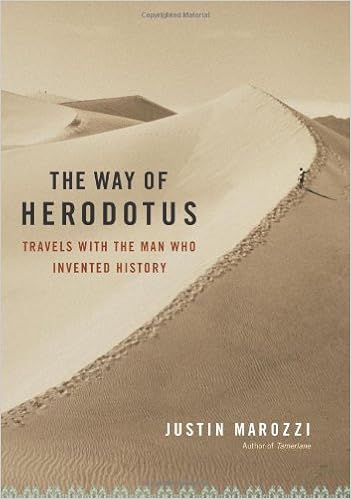


During the classical age of Greece, Herodotus wrote the first history text. But what he created was much more than this. Informed by his own travels, his historical work digresses more than it chronicles, with tales of the lands and peoples he visited. As Michael Ondaatje once famously suggested, “What you find in him are the cul-de-sacs within the sweep of history.” In The Way of Herodotus, intrepid travel historian Justin Marozzi retraces the footsteps of Herodotus through the Mediterranean and Middle East, examining his 2,500-year-old observations about the cultures and places he visited, and finding echoes of his legacy reverberating to this day. It is a lively yet thought-provoking excursion into the world of Herodotus, with the man who invented history ever present, guiding the narrative with his discursive spirit.

Hardcover: 384 pages
Publisher: Da Capo Press; First Edition edition (December 9, 2008)
Language: English
ISBN-10: 0306816210
ISBN-13: 978-0306816215
Product Dimensions: 8.9 x 6.4 x 1.3 inches
Shipping Weight: 1.2 pounds
Average Customer Review: 3.6 out of 5 stars See all reviews (16 customer reviews)
Best Sellers Rank: #1,765,881 in Books (See Top 100 in Books) #525 in Books > Travel > Europe > Greece > General #649 in Books > Travel > Middle East > General #766 in Books > History > Middle East > Iraq

When I studied history in graduate school we all had to read Herodotus. It was an obligation and I treated it as such; never much enjoying it but slogging through as best I could. I enjoyed the "father of history's" discussion of the Persian wars, but the travelogue Herodotus provided as an aside to his main story was a distraction for me. Had it been available then, I could have benefited from Justin Marozzi's book, "The Way of Herodotus." In this work Marozzi travels the same path that Herodotus took 2,500 years earlier. It took him to Turkey, Iraq, Egypt, and Greece to visit many of the same places that Herodotus wrote about. By far he spends the majority of the volume, more than 100 pages, discussing Greece. In every case he visits local sites, contacts a large number of people with varying perspectives on the region, the past, or Herodotus. Everywhere, Marozzi finds remnants of the Mediterranean and Middle Eastern cultures that Herodotus perceived.From my perspective the most interesting part of the book was when Marozzi encountered Nenad Sebek, director of the Centre for Democracy and Reconciliation in South-east Europe, in Thessalonki. He describes the Centre's Joint History Project to produce history textbooks for the Balkans. That yielded a fascinating set of discoveries. The first study undertaken by the Centre, "Clio in the Balkans," found that "the rewriting of history in Yugoslavia since 1989 has seen the suppression of those themes and forces that once unified its peoples and a fresh emphasis on those that divide them. Conflicts between them in the present are presented as unchanging throughout the past so that wars and separation are inevitable, what Christina Koulouri, series editor of the new textbooks, calls the `logic of dissolution'" (p. 250).
It is a pity that this is not a better book. Although (as the bibliography demonstrates) the notion of following the path trod by Herodotus is not original, Marozzi's title is nevertheless promising to history buff and travel/cultural enthusiast alike. But what follows is disappointing. Does the author intend to elucidate contemporary scenes with Herodotus' original observations or aim to provide a fresh take on Herodotus by light of current circumstances? Either could be amusing and possibly insightful. Unfortunately, the books accomplishes neither. The fan of Herodotus can empathize with Marozzi's waxing enthusiasm for this most original historian, but would be better served by simply re-reading the Histories, rather than picked-over extracts. On the other hand, for the reader hoping to gain insight into contemporary affairs in Iraq, Egypt, Greece, Turkey, etc. by contrasting author's reportage with Herodotus, the pickings are slim. It has been said that history (or developing events) quickly make fools of us all: One irony is that developments in most of these locations, even in the less than half-dozen years since the author's visits, already have subverted many of the lessons Marozzi seems to offer. Perhaps this is because his own reporting, much of it anecdotal, is surprisingly time-bound for someone touting historical perspective. Although Marozzi admonishes us at length to respect these diverse cultures (a genuine attribute of Herodotus), the author provides an oddly superficial picture of the contemporary cultures or circumstances being visited. Given his well-traveled resume, perhaps that is only a problem in the editing of this book --but it is striking.

The Way of Herodotus: Travels with the Man Who Invented History The Man Who Invented Fiction: How Cervantes Ushered in the Modern World Invented Eden: The Elusive, Disputed History of the Tasaday Burnside Breechloading Carbines and Rifles: A Collectors Guide to The Firearms and Cartridges Invented by The Famous Civil War General, Ambrose E. Burnside The Chip : How Two Americans Invented the Microchip and Launched a Revolution Sketch of the Analytical Engine Invented by Charles Babbage Wrist Watches Explained: How to fully appreciate one of the most complex machine ever invented The Power Makers: Steam, Electricity, and the Men Who Invented Modern America My Invented Country: A Memoir How the Scots Invented the Modern World: The True Story of How Western Europe's Poorest Nation Created Our World & Everything in It How the Scots Invented the Modern World: The True Story of How Western Europe's Poorest Nation Created Our World and Everything in It Creating Christ: How Roman Emperors Invented Christianity The Myth of Matriarchal Prehistory: Why an Invented Past Won't Give Women a Future Every Man's Marriage: An Every Man's Guide to Winning the Heart of a Woman (The Every Man Series) IRON MAN, VOL. 1: 1963-1980: Every Marvel IRON MAN Comic Book Cover From 1963 (Tales Of Suspense #39) And The 1968 Series (IRON MAN COMIC BOOK COVERS) Travels with Tooy: History, Memory, and the African American Imagination History: Human History in 50 Events: From Ancient Civilizations to Modern Times (World History, History Books, People History) (History in 50 Events Series Book 1) History: British History in 50 Events: From First Immigration to Modern Empire (English History, History Books, British History Textbook) (History in 50 Events Series Book 11) Rice, Noodle, Fish: Deep Travels Through Japan's Food Culture Green Kitchen Travels: Healthy Vegetarian Food Inspired by Our Adventures
