
Review (PDF) One Bugle, No Drums: The Marines At Chosin Reservoir
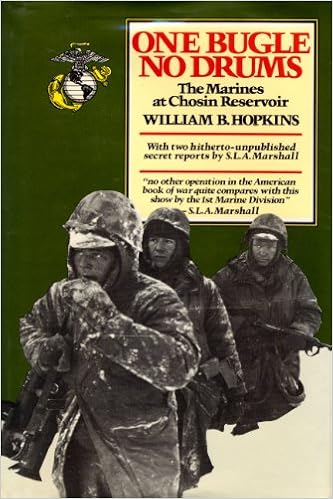


Korea, December 1950. The temperature has plunged to 20-degrees below zero. Cold enough to crack rocket-launcher ammo wide open. But not cold enough to stop a massive Communist assault against U.S. forces. As the 8th Army retreats, the Marines dig in at Chosin Reservoir and are quickly cut off and surrounded. This is the riveting account of what happened next. The brilliant Marine attack that was to become a classic in military operations. The personal heroism, private ordeals, bitter fighting, and final victory. Told in the powerful words of a man who was there, it is a story you will never forget.

Paperback: 306 pages
Publisher: Algonquin Books (September 28, 1986)
Language: English
ISBN-10: 0912697458
ISBN-13: 978-0912697451
Product Dimensions: 5.5 x 1 x 8.5 inches
Shipping Weight: 1 pounds (View shipping rates and policies)
Average Customer Review: 4.4 out of 5 stars See all reviews (28 customer reviews)
Best Sellers Rank: #1,406,039 in Books (See Top 100 in Books) #122 in Books > History > Military > Korean War > Campaigns #191 in Books > History > Asia > Korea > North #399 in Books > History > Military > Regiments

The author, a participant in the combat about which he writes, offers at least four strands of information emerging from the Marines response to the Chinese incursion into the Korean War: first, the human side of being a member of the Marine Corps in combat; second, the organizational response of the Marines to Chinese combat strategy; third, combat under conditions of extreme cold; fourth, opinions about the highest levels of American military and political decision-making in the movement North to the Chosin area.The last strand one can take or leave, since they are the ground level observations of one who had no intimate knowledge of the basis for the decisions. My own reaction was to take note and pass on since there is now so much detailed and informed discussion available elsewhere. It is the three other elements which continue to make the book useful reading for the lay reader wanting to know something about what is often referred to today, as the "forgotten war". On the first point, he is able to convey something of the feelings of an ordinary WW2 veteran who stayed on in the Marine reserve after its end and then found himself called up to serve under conditions of extreme difficulty. The second point is a good historical one pointing up some of the factors which made the Marines successful where the Army in that stage did not fare nearly as well. (One element he did not mention at all: ,most of the Army men were the product of reserve units and draftees who had never seriously been trained for combat and, through no fault of their own, went in like lambs to the slaughter). Most useful of all is the front line image of just what extreme cold can do to even the best trained of soldiers and otherwise good equipment (on both sides of the combat line).
Hopkins', "One Bugle, No Drums" is a marvelous look at one small slice of the Korean War; the battle near the Chosen Reservoir in North Korea. In a battle against four to one odds and in the coldest weather ever ought in, the 1st Marine Division, surrounded by a Chinese and North Korean Army numbering several 100,000's fought their way to safety and literally destroyed the fighting ability of their adversary.The Korean War was the last of its kind, and likely will the the last, unless one considers the still to come Battle of Armageddon, where there were identifiable front lines across which the adversaries face off against each other.Initially, the war suffered from a number of serious short-comings: America was unprepared for war, with insufficient and largely untrained soldiers (with the exception of the Marines) and poorly equipped as well, American military High Command remained in Japan, far removed from the fighting men,. The intelligence gathered and disseminated from Japan was almost universally faulty and bore little semblance to the conditions on the battlefield. Lastly, the belief on the part of America's political leaders and the Military High Command that the Chinese would not enter the war proved to be totally wrong and resulted in a number of serious miscalculations resulting in unnecessary loss of life.Another miscalculation was the decision to separate American forces into smaller units and move rapidly toward the North Korean border with China. This resulted in large numbers of American forces being surrounded causing the destruction of a large part of an Army Division and the 1st Marines having to battle their way to safety.

One Bugle, No Drums: The Marines at Chosin Reservoir The Frozen Chosen: The 1st Marine Division and the Battle of the Chosin Reservoir (General Military) Colder Than Hell: A Marine Rifle Company at Chosin Reservoir Colder than Hell: A Marine Rifle Company at Chosin Reservoir (Bluejacket Books) Cooking for One: 365 Recipes For One, Quick and Easy Recipes (Healthy Cooking for One, Easy Cooking for One, One Pot, One Pan) Brecht Collected Plays: 1: Baal; Drums in the Night; In the Jungle of Cities; Life of Edward II of England; & 5 One Act Plays (World Classics) (Vol 1) How to Boil an Egg: Poach One, Scramble One, Fry One, Bake One, Steam One The Drums of Noto Hanto Vintage Snare Drums - The Curotto Collection: Volume 1: Rare American-Made 1900s to 1940s Cuba and Its Music: From the First Drums to the Mambo Chosin: Heroic Ordeal of the Korean War East of Chosin: Entrapment and Breakout in Korea, 1950 (Williams-Ford Texas A&M University Military History Series) East of Chosin: Entrapment and Breakout in Korea, 1950 (Williams-Ford Texas A&M University Military History Series) by Appleman, Roy E. (9/1/1990) Drums Of Autumn (Outlander, Book 4) Drums of War (Blue Phoenix Book 3) The Practice of Reservoir Engineering (Revised Edition), Volume 36 (Developments in Petroleum Science) Phase Behavior of Petroleum Reservoir Fluids Fundamentals of Reservoir Engineering, Volume 8 (Developments in Petroleum Science) Applied Petroleum Reservoir Engineering (3rd Edition) Practical Enhanced Reservoir Engineering: Assisted with Simulation Software
