
Review (PDF) Indian Philosophy: Volume I: With An Introduction By J.N. Mohanty (Oxford India Collection) (Oxford India Collection (Paperback))
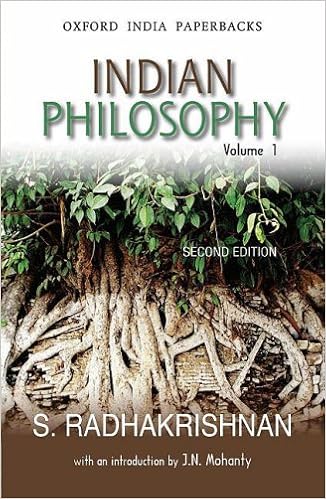


This classic work is a general introduction to Indian philosophy that covers the Vedic and Epic periods, including expositions on the hymns of the Rig Veda, the Upanisads, Jainism, Buddhism and the theism of the Bhagvadgita. Long acknowledged as a classic, this pioneering survey of Indian thought charts a fascinating course through an intricate history. From the Rig Veda to Ramanuja, Radhakrishnan traces the development of Indian philosophy as a single tradition of thought through the ages. The author showcases ancient philosophical texts and relates them to contemporary issues of philosophy and religion. This second edition with a new Introduction by eminent philosopher J.N. Mohanty, highlights the continuing relevance of the work and the philosophic tradition it represents.

Series: Oxford India Collection (Paperback)
Paperback: 664 pages
Publisher: Oxford University Press; 2 edition (January 15, 2009)
Language: English
ISBN-10: 019569841X
ISBN-13: 978-0195698411
Product Dimensions: 8.4 x 1.2 x 5.4 inches
Shipping Weight: 1.5 pounds (View shipping rates and policies)
Average Customer Review: 4.8 out of 5 stars See all reviews (6 customer reviews)
Best Sellers Rank: #767,360 in Books (See Top 100 in Books) #118 in Books > History > World > Religious > Hinduism #246 in Books > Politics & Social Sciences > Philosophy > Eastern > Indian #276 in Books > History > World > Religious > Buddhism

An acknowledged scholar, S.Radhakrishnan, in this classic holds you by hand and takes you through the myriad hues of Indian Philosophy. The result is an honest and at times brutal appraisal of the works of thinkers of the bygone era. Radhakrishnan's consummate ease with the subject comes out in no uncertain terms. The book left me spell bound and answered questions which have been plaguing me for some time now. The book with its well laid out chapters is full of clarity and is scholarly.To start off, His evaluation of the Vedas is clinical - "The religion of Vedas certainly more joyous, but it was a lower form of religion where thought never penetrated beneath the husk of things." "Men's relations with the gods were mechanical, a question of give and take, profit and loss."He completely adores the Upanishads and comes out as one on home turf when dealing with them. He never misses an opportunity to praise them profusely. It is worth quoting the famous Deussen lines on Upanishads here - "but one thing we may assert with confidence - whatever new and unwonted paths the philosophy of the future may strike out, this principle will remain permanently unshaken, and from it no deviation can possibly take place." You can see him getting despondent in the last section of the chapter titled 'Philosophy of the Upanishads'. To quote him from there "But the true was overwhelmed by the false".Jaina logic and its strong ethical system stand out.
Scholarly and immense, but in accessible Victorian prose. I'm not surprised it's remained the standard text for so long - who would now even begin to attempt to collate the whole of a civilisation's philosophy! Simultaneously ambitious and sprawling, complete and partial, disciplined and wayward, pedantic and phantastic, objective and personal, this worthy tome is a gathering and a marker. It serves well as fundamental introduction to the avenues of understanding that the mode of `Indian' experience must go down to achieve wisdom.Some prior interest in Indian philosophy - and therefore some patience - is presumed even in its Victorian compendiousness. My interest in reading often depended on which parts I found most pertinent. The first hundred pages or so go over the polytheism/henotheism of the Veda, and there is some accounting of the various Hindu deities etc. I was happier once we got to the Upanishads and, from there, the on-going reconfigurations and considerations of the absolute that is the contribution of India to world philosophy - the various formulations of the ground that have been overlooked [or one of which has been posited thoughtlessly as absolute and primary] by the narrower, religiously influenced `western' tradition.But for such an apparently comprehensive tome, it does sometimes feel sketchy. The book is not self-contained. Radhakrishnan frequently refers to things he himself hasn't yet described within his own text: he references sunyata without having explained what that might be. In fact, he steers clear of an exposition of the way in which Buddhism might be fundamentally different to Hinduism. It increasingly appears, in the course of his writing, that Radhakrishnan is not entirely self-effacing.

Indian Philosophy: Volume I: with an Introduction by J.N. Mohanty (Oxford India Collection) (Oxford India Collection (Paperback)) Indian Cooking: for Beginners - Indian Recipes Cookbook 101 - Indian Cuisine - Indian Culinary Traditions (Indian Food Recipes - Indian Food Cookbook for Beginners) A History of the Sikhs: Volume 2: 1839-2004 (Oxford India Collection) (Oxford India Collection (Paperback)) The End of Comparative Philosophy and the Task of Comparative Thinking: Heidegger, Derrida, and Daoism (SUNY Series in Chinese Philosophy and Culture) ... Chinese Philosophy and Culture (Paperback)) The Book of Indian Crafts and Indian Lore: The Perfect Guide to Creating Your Own Indian-Style Artifacts Alberuni's India. An account of the religion, philosophy, literature, geography, chronology, astronomy, customs, laws and astrology of India about A.D. 1030 VOL. 1 Indian Home Cooking: A Fresh Introduction to Indian Food, with More Than 150 Recipes Sources of Indian Tradition, Vol. 2: Modern India and Pakistan (Introduction to Oriental Civilizations) Philosophy Of Law: An Introduction To Jurisprudence (Dimensions of Philosophy Series) The Crisis of European Sciences and Transcendental Phenomenology: An Introduction to Phenomenological Philosophy (Northwestern University Studies in Phenomenology & Existential Philosophy) A History of Philosophy, Volume 3: Late Medieval and Renaissance Philosophy: Ockham, Francis Bacon, and the Beginning of the Modern World Indian Takeout Cookbook: Favorite Indian Food Takeout Recipes to Make at Home Entice With Spice: Easy Indian Recipes for Busy People [Indian Cookbook, 95 Recipes] Indian Cooking Unfolded: A Master Class in Indian Cooking, with 100 Easy Recipes Using 10 Ingredients or Less Easy Indian Cookbook: The Step-by-Step Guide to Deliciously Easy Indian Food at Home American Indian Jewelry I: 1200 Artist Biographies (American Indian Art Series) Southwestern Indian Baskets: Their History and Their Makers (Studies in American Indian Art) California Indian Baskets: San Diego to Santa Barbara and Beyond to the San Joaquin Valley, Mountains and Deserts (Indian Baskets of California and Oregon, Vol. II) Corn Is Our Blood: Culture and Ethnic Identity in a Contemporary Aztec Indian Village (The Civilization of American Indian Series, Vol 206) The Dawes Act and the Allotment of Indian Lands (The Civilization of the American Indian Series)
