
Review (PDF) A History Of Modern Yemen
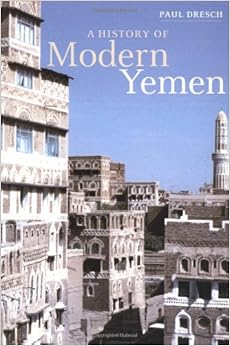


Yemen's modern history is unique and deserves to be better understood. While the borders of most Middle East states were defined by colonial powers after the collapse of the Ottoman Empire, a single Yemeni state was not formed until 1990. In fact, much of Yemen's twentieth-century history was taken up constructing such a state, forged after years of civil war. The book is augmented by illustrations, maps and a detailed chronology.

Paperback: 304 pages
Publisher: Cambridge University Press; 1 edition (January 3, 2001)
Language: English
ISBN-10: 052179482X
ISBN-13: 978-0521794824
Product Dimensions: 6 x 0.6 x 9 inches
Shipping Weight: 1.1 pounds (View shipping rates and policies)
Average Customer Review: 3.5 out of 5 stars See all reviews (4 customer reviews)
Best Sellers Rank: #1,249,118 in Books (See Top 100 in Books) #38 in Books > History > Middle East > Yemen #1153 in Books > Textbooks > Humanities > History > Middle East

Written eleven years ago in 2000, Dresch's work is even more relevant today, as the "war on terrorism" which conflates with "the war for US interests everywhere" continues and finds a particular focus of tension in Yemen. While the author definitely describes the rise of Islamist schools and political groups in the imperfectly-welded parts of this ancient land, even a cursory reading of A MODERN HISTORY.... will lead to the realization that much of the Western media have little or no idea what is going on there. I fear the same is true of the politicians and decision makers.Yemen is a most complex country, divided in many ways, but making up a society nevertheless. Tribes, religious factions (all Islamic), economic, military, and political groups create complex webs with a bedrock underlay of personal and family ties, making predictions about who will do what extremely difficult. Dresch tackles Yemen only from the beginning of the Imam Yahya's reign in 1906. Right there you come to a problem....do you say "reign" when speaking about an Imam, not a king ? Yemen moved from an Imamate with little feeling of nationhood in the modern sense, to being more of a kingdom. The British had occupied the port of Aden in the 19th century and gradually extended their sway over the entire southern and eastern stretches of what had been known as "Yemen", a region. When the second modern Imam died in 1962, modernists tried to take control, only to face a vastly confusing civil war in which both Egypt (military) and Saudi Arabia (money) took part. The south freed itself from British rule by 1968 and turned into a (would-be) Marxist state which still displayed firm Yemeni characteristics.

A History of Modern Yemen History: Human History in 50 Events: From Ancient Civilizations to Modern Times (World History, History Books, People History) (History in 50 Events Series Book 1) History: British History in 50 Events: From First Immigration to Modern Empire (English History, History Books, British History Textbook) (History in 50 Events Series Book 11) Yemen:: Revolution, Civil War and Unification (Library of Modern Middle East Studies) A Tribal Order: Politics and Law in the Mountains of Yemen (Modern Middle East (Paperback)) A Tale of Two Factions: Myth, Memory, and Identity in Ottoman Egypt and Yemen (Suny Series in the Social and Economic History of the Middle East) Arabia Felix: An Exploration of the Archaeological History of Yemen (Origins of Arabia) The Differential Impact of Women's Participation in the Arab Spring - Social Media, Information Technology, Group Identities, Egypt, Yemen, Bahrain, Barriers to Protest, Gender Participation The Last Refuge: Yemen, al-Qaeda, and America's War in Arabia Unfinished Revolutions: Yemen, Libya, and Tunisia after the Arab Spring Yemen: Dancing on the Heads of Snakes Yemen Chronicle: An Anthropology of War and Mediation Water Histories and Spatial Archaeology: Ancient Yemen and the American West Regionalism and Rebellion in Yemen: A Troubled National Union (Cambridge Middle East Studies) The Struggle For Yemen And The Challenge of Al-Qaeda In The Arabian Peninsula: 2013 Salafism in Yemen: Transnationalism and Religious Identity Nasser's Gamble: How Intervention in Yemen Caused the Six-Day War and the Decline of Egyptian Power Aden Insurgency: The Savage War in Yemen 1962-67 High-Value Target: Countering al Qaeda in Yemen (ADST-DACOR Diplomats and Diplomacy) Yemen: The Unknown Arabia
