
Review (PDF) The Pivot Of The Universe: Nasir Al-Din Shah And The Iranian Monarchy, 1831-1896
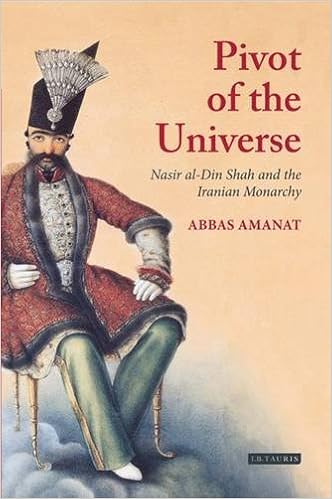


When he was assassinated in 1896, Nasir al-Din Shah had sat on the Peacock throne for nearly half a century. A colorful, complex figure, he is frequently portrayed as indolent and self-indulgent. Yet he was in many ways an effective ruler who displayed exceptional resilience in the face of dilemmas and vulnerabilities shared by most monarchs of the Islamic world in the nineteenth century. In this book--the first in English about Nasir al-Din Shah--Abbas Amanat gives us both a biography of the man and an analysis of the institution of monarchy in modern Iran. Nasir al-Din Shah developed from an insecure crown prince and later an erratic boy-king in the 1840s and 50s into a ruler with substantial control over his government and foreign policy in the 1860s and beyond. Amanat examines this transformation and explores how traditional monarchies drew strength as they accommodated themselves to the forces of modernity.Based on extensive archival research in both public and private collections and illustrated with drawings and photographs from the period, Pivot of the Universe offers a fresh interpretation of the evolution of monarchy in modern times as it interacted with the institutions of government, the society at large and Western powers.

Paperback: 568 pages
Publisher: I.B.Tauris; Revised edition (November 15, 2008)
Language: English
ISBN-10: 1845118286
ISBN-13: 978-1845118280
Product Dimensions: 6 x 1.6 x 9.2 inches
Shipping Weight: 1.8 pounds (View shipping rates and policies)
Average Customer Review: 5.0 out of 5 stars See all reviews (3 customer reviews)
Best Sellers Rank: #729,226 in Books (See Top 100 in Books) #309 in Books > History > Middle East > Iran #570 in Books > Biographies & Memoirs > Historical > Middle East #653 in Books > Textbooks > Humanities > History > Middle East

My compliments to Professor Amanat on this incredible book on the reign of Nasir al- Din Shah Qajar of Iran. What a refreshing new look on this Qajar ruler. Although Professor Amanat's book concentrates on the first half of Nasir al-Din's monarchy, his work is of great historical and academic value to Iranian history. Since the dawn of the Pahlavi Dynasty in the 1920's, Nasir al-Din has always been presented in a vacuum, by a resume style listing of events in his political career. These highlights of Nasir al-Din Shah's monarchy have shaped the popular understanding of this ruler. Most importantly, the killing of, Mirza Taqi Farahani (Amir Kabir), his disliked mother (Malik Jahan, Mahd `Ulya), Nuri, his unpopular premier, the Herat military campaign, the Anglo-Iranian War, the Babi suppression (Baha-i Koshi), foreign intervention in domestic affairs, obsession with Malijak (Aziz-al- sultan), the tobacco concession, and his assassination in 1896. In this book, we finally get to understand Nasir al-Din by learning about his childhood, his world, and his time. What one learns from reading Professor Amanat's book is that ruling Persia during the age of Europe's Imperial expansion, industrialization, and modernization, Nasir al-Din was able to prove himself quite effectively as an astute diplomat. What he lacked in military might, he made up for in diplomatic wit, playing the great powers against one another (namely Britain and Russia). What has never been acknowledged about him prior to this book is that he fared quite well in his attempt to assure Iranian territorial integrity and independence (preventing the partitioning of Iran). Professor Amanat does not in any way put Nasir al-Din at par with Peter the Great, Nadir Shah, or Napoleon.
For the Qajar dynasty of Iran, the mid-nineteenth century was a period of considerable challenge. Though they had succeeded in securing their claim to the throne, their rule was but a pale shadow of the monarchy that had dominated the region during Safavid times. Domestically their regime grappled with unrest and westernizing pressures, while internationally they found themselves a pawn in the geopolitical struggle between the Western empires of Britain and Russia. These challenges dominated the reign of Nasir al-Din Shah, who ruled over Iran for nearly half a century. Though his reign has long been the subject of considerable study, with this book Abbas Amanat has provided the first biography in English of Nasir, offering a detailed study of his life and times.Yet Amanat's book is not a full accounting of Nasir's life. His focus is on the shah's early years and the first twenty-three years of his lengthy reign. These he sees as critical years in the evolution of the institution of the Iranian monarchy, as it abandoned many of its medieval institutions and developed into a more modern absolutist monarchy. This was not without considerable struggle, nor did it begin with Nasir himself. By the early nineteenth century, the Qajars committed themselves to the notion of primogeniture as a means of determining succession, yet Nasir's path to the throne was plagued with potential challengers from within his family. His successful accession was due in part to the sounds advice of Amir Nizam, who soon afterwards became Nasir's chief minister. Yet his time in power was short, and Nizam's dismissal (and subsequent execution) represented the end of his efforts to institute a range of modernizing reforms.

The Pivot of the Universe: Nasir al-Din Shah and the Iranian Monarchy, 1831-1896 Standard Catalog of American Light-Duty Trucks: Pickups, Panels, Vans, All Models 1896-2000 (Standard Catalog of American Light-Duty Trucks, 1896-2000) Learn to Write DAX: A practical guide to learning Power Pivot for Excel and Power BI Voices of the Wild: Animal Songs, Human Din, and the Call to Save Natural Soundscapes (The Future Series) Shah of Shahs The Shahnama of Shah Tahmasp: The Persian Book of Kings (Metropolitan Museum of Art) Reading Mystical Lyric (Studies in Comparative Religion): The Case of Jalal Al-Din Rumi (Studies in Comparative Religion) Myths of Harmony: Race and Republicanism during the Age of Revolution, Colombia, 1795-1831 (Pitt Latin American Series) New Year in Cuba: Mary Gardner Lowell's Travel Diary, 1831-1832 (New England Women's Diaries Series) FRANKENSTEIN or The Modern Prometheus (The Revised 1831 Edition - Wisehouse Classics) Democracy--The God That Failed: The Economics and Politics of Monarchy, Democracy, and Natural Order (Perspectives on Democratic Practice) Understanding Contemporary Ethiopia: Monarchy, Revolution and the Legacy of Meles Zenawi Colombia's Military and Brazil's Monarchy: Undermining the Republican Foundations of South American Independence (Contributions in Political Science) The Social and Economic Origins of Monarchy in Jordan (Middle East Today) La monarquia de Espana y sus visitantes/ The Spain monarchy and its visitors: Siglos XVI Al XIX/ Centuries XVI Al XIX (Spanish Edition) Official Handbook of the Marvel Universe A to Z Volume 2 (Official Handbook to the Marvel Universe a to Z) History of Trinidad from 1781-1839 and 1891-1896 (Cass Library of West Indian Studies,) History of Trinidad from 1781-1839 and 1891-1896 Heisey Glass- The Early Years: 1896-1924 Heisey Glassware: The Early Years: 1896-1924
