
Review (PDF) Democratic Governance And International Law
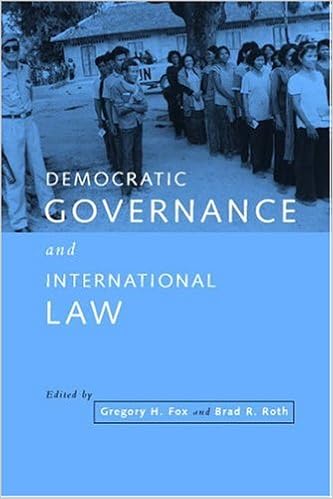


This book considers how the post-Cold War democratic revolution has affected international law. Traditionally, international law said little about the way in which governments were chosen. In the 1990s, however, international law has been deployed to encourage transitions to democracy, and to justify the armed expulsion of military juntas that overthrow elected regimes. In this volume, leading international legal scholars assess this change in international law and ask whether a commitment to democracy is consistent with the structure and rules of the international legal system.

Paperback: 600 pages
Publisher: Cambridge University Press (May 29, 2000)
Language: English
ISBN-10: 0521667968
ISBN-13: 978-0521667968
Product Dimensions: 6 x 1.3 x 9 inches
Shipping Weight: 2 pounds (View shipping rates and policies)
Average Customer Review: 5.0 out of 5 stars See all reviews (1 customer review)
Best Sellers Rank: #2,622,290 in Books (See Top 100 in Books) #111 in Books > Law > Specialties > Air & Space #1252 in Books > Law > Philosophy #3284 in Books > Law > Foreign & International Law

Suppose you were living in a village of thirteen people. You and your neighbors elected one person to be the mayor of your village, and made virtually all public decisions by referendums allowing your mayor to put your decisions into action. You would invariably manage few resources, and exert little power on the communities around you; however, you would have a substantial degree of control in your affairs. Now suppose you moved to a village of approximately 63 billion. You now have a village council, a mayor, a local representative, a governor, a national representative, a president or prime minister, and an international representative. There are thousands of issues decided each day, some of these are legislative issues bound to become laws, some judicial decisions that will have legal bearing - all will effect you and your life. Consequently, the degree of control you can exert over your own affairs has virtually evaporated. What happened to the spread of liberal democracy? This much needed text answers these questions with lucid professionalism and keen insight. In a world where the theory of a "global village" is increasingly and increasingly convincingly being advanced, international law theoretically also becomes increasingly necessary - this global village is interdependent, and thus there must be universality to the laws. Messrs. Fox and Roth provide a practical response to theory with this excellent text, which is divided up into five parts: (1) the normative foundations of a right to political participation; (2) democracy and inter-state relations; (3) democracy and the use of force; (4) democratization and conflicting imperatives; and, (5) critical approaches. There are several chapters within each of these larger parts, each chapter is an essay contributed by a significant legal or international studies scholars. For students of any international interest this text is indispensable to forming cogent arguments and/or proposals.

Democratic Governance and International Law Microsoft SharePoint 2013 Planning for Adoption and Governance: Planning for Adoption and Governance Marine Environmental Governance: From International Law to Local Practice International Law and International Relations (International Relations for the 21st Century) Maritime Piracy and the Construction of Global Governance (New International Relations) The New Dynamics of Multilateralism: Diplomacy, International Organizations, and Global Governance The Politics of Global Governance: International Organizations in an Interdependent World Reading Humanitarian Intervention: Human Rights and the Use of Force in International Law (Cambridge Studies in International and Comparative Law) The Fair and Equitable Treatment Standard in International Foreign Investment Law (Oxford Monographs in International Law) Research Handbook on International Law and Migration (Research Handbooks in International Law Series) (Elgar Original reference) The Transit of Goods in Public International Law (Developments in International Law) The Interpretation of International Law by Domestic Courts: Uniformity, Diversity, Convergence (International Law in Domestic Legal Orders) Significant Changes to the International Plumbing Code, International Mechanical Code and International Fuel Gas Code, 2012 Edition Constitutive Visions: Indigeneity and Commonplaces of National Identity in Republican Ecuador (Rhetoric and Democratic Deliberation) (Volume 9) Democracy--The God That Failed: The Economics and Politics of Monarchy, Democracy, and Natural Order (Perspectives on Democratic Practice) Water on Tap: Rights and Regulation in the Transnational Governance of Urban Water Services (Cambridge Studies in Law and Society) Democratic Insecurities: Violence, Trauma, and Intervention in Haiti (California Series in Public Anthropology) The Struggle for Democratic Politics in the Dominican Republic (H. Eugene and Lillian Youngs Lehman Series) Do the Poor Count?: Democratic Institutions and Accountability in a Context of Poverty Stealing America: What My Experience with Criminal Gangs Taught Me about Obama, Hillary, and the Democratic Party
